
Afghanistan's Diplomatic Mission Under Pressure from U.S. State Department
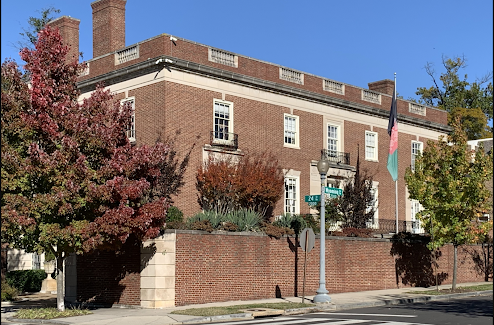
Afghanistan's flag flutters outside the Afghanistan embassy in Washington, DC. (Photo Source)
The collapse of Afghanistan's government was a catastrophic event for all Afghans, but for perhaps no one more so than for staff of Afghanistan’s diplomatic missions in the United States whose employees are not only distressed financially but also oppressed politically. For months now, Afghan diplomats and staff have not received their salaries and recently, the U.S. State Department has pressured them to limit their diplomatic activities and asked them not to speak to the media.

After the sudden fall of Kabul to the Taliban on August 15, the US decided to freeze nearly $9.5 billion in assets belonging to the Afghan central bank. In addition, it froze all accounts belonging to the Afghan government, including those belonging to Afghanistan's diplomatic missions, its embassy in Washington D.C. and consulates in New York and Los Angeles.

The Afghanistan embassy recently shut its consulate and resumed its services through the embassy in DC because it lacked sufficient funds to pay the rent and utilities, according to an embassy employee who asked to remain anonymous. Dozens of diplomats have not received their salaries, local staff at all Afghan diplomatic missions are laid off. The embassy and its consulates in New York City and Los Angeles remain for now, though employees are not mandated to show up for work. 

Afghan consulates are still trying to offer a range of services to Afghan citizens, such as passport renewal, issuing birth and marriage certificates, and document validation but with their account frozen, it cannot cash money orders. The embassy has recently started asking its customers to pay fees for these services in cash, but the amount they collect each week doesn’t cover the the inutility bills. 

Worse, the U.S. State Department has recently begun demanding the Afghan embassy limit its diplomatic activities, since Afghanistan is now under the control of the Taliban. Afghan diplomats have also been asked to abstain from speaking about the US withdrawal from Afghanistan or complaining about their frozen bank accounts. The anonymous diplomat told me that when asked, the State Department has repeatedly said they are in talks with the US treasury and the Department of Justice to release some funds, but so far, the embassies and consulates have had to try and operate without access to funds or bank accounts.

Adela Raz, Afghanistan’s ambassador to the United States, has also been under pressure from the State Department. According to Afghan diplomats, the State Department has urged her not to criticize the Biden administration, after she told Axios that "President Biden doesn't care about the fate of Afghan women and girls."

Desperation over embassy's account closure and pressure by the State Department has led to internal conflict. The diplomats and staff at the embassy are also at odds with Adela Raz who is still claiming to be leading Afghanistan's diplomatic mission. [This part that claimed Raz received cash gifts from other diplomatic missions is being removed after a cross-check for accuracy.] The staff at the Afghan embassy are preparing a press release to declare that the Afghanistan embassy has not received any cash gifts or donations from any entities.

According to employees, the Afghan embassy in DC and its consulates in New York and Los Angeles may soon close. It is now nearly for months staff have not received their salaries; the embassy has not paid its utility bills since its accounts were frozen in mid-August. Outside the embassy, diplomats struggle to pay their rent, utility bills and even buy winter clothes for their children. Those who lived with their families in government-sponsored housing have been forced to move out because they could not afford paying their rents without government support, and some families with sick members have been unable to afford doctor visits, since they lost their insurance when Kabul fell to the Taliban. I was told by several diplomats they are considering shutting down their diplomatic missions at the end of January if the US government does not unfreeze its employees’ salaries because they cannot afford rent, and some may apply for asylum in the U.S. while others are planning to escape to Canada.

Comments

Popular posts from this blog

The Root Cause of Green on Blue Attacks

Note: I published this article first on  openDemocracy ‘Green on blue attacks' is the name given to a growing series of incidents where seemingly rogue Afghan security forces turn their guns on their NATO counterparts. These insider attacks have led to the deaths of more than 50 NATO troops since the beginning of 2012. Subsequently, NATO responded in September by halting joint operations with Afghan security forces to prevent further attacks, following the deaths of 6 International Security Assistance Force (ISAF) troops over one weekend .   With the increased frequency of green on blue attacks, the topic has become an important subject for western media. It is usually portrayed as a religious and cultural problem in which Afghan troops react to perceived insults by American troops’ behavior. Others cite Taliban infiltration into Afghan security forces. But after talking to various Afghan journalists and writers who have been covering this issue for the past decade, ...

Discussing the "Green on Blue" attacks with BBC World News

Here I discussed the impact of the "green on blue" attacks by members of the Afghan police and army against coalition forces in Afghanistan and NATO airstrike which killed 8 women who were out gathering firewood before dawn.

Individuals Matter

Individual leadership matters, and leaders make a difference in international relations. There is some empirical evidence that individuals have played an essential role in international relations. In IR, the form of government is not as important as the leadership. Sometimes, the public domain and internal politics are personified in leadership. In Farsi, there is a proverb that goes "what leaks out of the ewer is what is inside it"[از کوزه همان تراود که دراوست],or as it goes in English, "a tree is known by its fruit." Let's consider Ahmadinejad of Iran's leadership, for example. During his two-term presidency, he had been one of the most controversial figures in the international sphere. If Ahmadinejad had not called Israel a “tumor” and had not reiterated the words of former Supreme Leader Ayatollah Khomeini, by saying that Israel should be wiped off the map, today, Iran might have a different status in international relations. Furthermore, if Ahmadinej...

Learning Online Journalism and Writing Blogs in Helmand Province

Note that this article was first published in the America.gov ( direct link of this interview )and if you reproduce this article you must retain this notice. ----- Introduction: A surprising number of Afghans blog on the Internet and even more want to learn how. Nasim Fekrat has been at the forefront of helping Afghans use modern technology to communicate with each other and the rest of the world – but it can be a dangerous business. America.gov’s Jane Morse talked with him earlier this year while he was in United States on a fellowship (see: Eager to Learn About the World, Tech Savy Afghans Turn to Blogs .) In a new guest post, Nasim talks about his latest efforts to teach blogging in Helmand province, the largest in Afghanistan and the world’s top opium-producing region. The province is the site of ongoing deadly fighting between the Taliban and American, British and other NATO troops. This is the sixth day that I am in the war-torn province of Helmand. My friends in other...

Rejoicing over the Death of an Evil Person

In 2013, when Margaret Thatcher died, some people celebrated her death--due to her destructive economic policies during her terms--not only in the UK  but also in other places, like  Chile . Rejoicing over her death was not only considered something unethical but a source of joy and happiness.   Today I heard that Mujib Rahman Ansari, a senior Sunni extremist  cleric and pro-Taliban, was killed in a blast . On social media platforms, many Afghanistanis expressed their happiness over his death. The first question that might come to our mind is, is this morally a good thing? This is not the right question. A more correct and accurate question to ask is whether the absence of someone who promoted and caused hatred, disgust, misery, and suffering brings us peace?  I asked a friend of mine this question. He told me that "rejoicing over the death of an evil person should not only be considered normal but also morally justifiable. We humans naturally rejoice ...

How does NATO determine who is insurgent and who is not?

On September 16th, 2012, AFP reported that NATO troops killed eight Afghan women in an airstrike. These women were on a mountainside collecting firewood for fuel in a small village in the Alingar district of the Laghman province. According to the report, ISAF spokesman Lieutenant Colonel Hagen Messer said that the shooting happened at around 1:00 am (2030 GMT Saturday) . Considering Afghan society and especially Pashtun traditions, it is almost impossible to believe that they would let their women go out in middle of the night, in complete darkness to collect wood. Traditionally, it is immoral and against Pashtun culture to let their women go out, especially in the dark, for work. Moreover, it makes the story murkier when it says the women were in the woods at 2:00AM because they cannot see in the dark. Usually, Afghans collect firewood and pile them next to their houses and huts and it is the men’s job not women’s job. The AFP and New York Times (NYT claims the airstrike hap...

Ta’arof as a Denial in Iranian Social Life

Christopher de Bellaigue who is the author of the new book Patriot of Persia: Muhammad Mossadegh and a Tragic Anglo-American Coup has published an article on the Atlantic , explaining the complexity of ta’arof in Iran. Ta’arof is a borrowed word from Arabic which is simply used for introductions and meeting people. In Farsi ta’arof is a form of polite behavior shown among Farsi speakers in Iran. It is a delightful and respectful interaction but at the same time it is a form denial and dishonesty. As Bellaigue explains ta’arof is “symptomatic of a broader Iranian tendency to clothe every­thing in ambiguity—and to spend an inordinate amount of time doing so.” Bellaigue, whose wife is Iranian, applied for Iranian citizenship eight years ago. Each time he went to the Department of Alien Affairs, he was welcomed warmly and offered tea and then asked to visit again. He says since ta’arof has an open ending, 8 years later, he is still waiting for his citizenship. Ta’arof as much...

America's Drone War Stoned by Afghans

Apparently this drone has crashed three weeks ago. According to PressTV, the unmanned drone has crashed in western province of Herat . From people's words in the video, it appears that the incident has happened in a Pashtun area. Nothing has yet said or published online by American officials in Afghanistan to disclose any details about the incident. The militants has claimed they have shot it down and then they have taken away the wreckage of aerial vehicle. Since the incident happened in Herat province, which is coterminous with Iran, it might be possible that the Taliban have sold it to Iran. If the Taliban have not sold it to Iran, then, one would wonder, what use the wreckage of drone may have to the Taliban? Apparently nothing and they may destroy it by throwing stones at it, as they do in this video. A friend of friend who had shared this video on his facebook page sarcastically titled "the stranded pilgrim." According to some, this beast has done a great job...

For The First Time: Blogging Workshop in Kabul

-------- For the first time in Afghanistan , a two days Blogging workshop was organized by the Afghan Association of Blog Writers . The participants were an Afghan journalist, a University teacher, a poet and writers from different provinces and of various ethnic backgrounds. The main goals of this workshop are better access of journalists to weblogs and other digital media. Since Afghan print and internet media are of a very low quality, blogs could help the Afghan print media and become a milestone in the media situation in Afghanistan . This was just the first blogging workshop in Afghanistan . The plan is to continue with more workshops in different parts of Afghanistan , including Herat , Mazar-e- Sharif, Jalalabad, Kandahar , Bamyan and Daikundi. Cultural activities in cyberspace, theories of blogging, detailed similarities and differences between web sites and weblogs, and the techniques of making a blog were discussed in these two workshop days. And at the end, ea...

Decline of Iran's Soft Power in Afghanistan

Stanford: CREEES seminar: "Iran and the Hazaras of Afghanistan: The Decline of Tehran's Soft Power" Short synopsis of my talk’s proposed content: Iran’s influence in Afghanistan is unique in that it has not historically derived from support for militant groups, but instead from “soft power” especially through Afghanistan’s Shiite Hazaras people.  The Hazaras share language, religion and culture with Iran, and constitute approximately 10-15 percent of the Afghan population. Over the last four years, Iran has accelerated its soft power efforts through Hazaras by investing in construction projects, increasing trade and promoting its ideology. Iran has also engaged in cultural exchange programs and provided humanitarian aid and scholarships.  Books, DVDs and pamphlets promoting anti-Zionist and anti-American sentiments have been distributed to Hazara communities. Despite investing significant resources in these efforts, Iran has not achieved the influence ...